
There's a moment every plant milk fan knows well: you steam your oat milk to silky perfection, pour it over espresso, and watch the foam deflate before you even pick up the cup. It's not a coincidence — and it's not just your technique. The ability of any milk, dairy or plant-based, to foam and hold that foam comes down to specific ingredients and how they interact under heat and pressure.
So what's actually happening in the pitcher, and which ingredients make the difference between a latte-worthy froth and a sad, flat cup?

Foam is essentially air trapped inside a liquid structure. For that structure to hold, you need two things: proteins to create the bubble walls, and stabilizers to keep those walls from collapsing, or just a lot of real protein fat! In dairy milk, casein and whey proteins do most of this work naturally. Plant milks have to engineer their way to a similar result — and the ingredients used tell you everything about how well they'll perform.
So What Helps?
1. Protein — The Foundation of Every Bubble
Protein is the single most important factor in foam stability. When you steam or froth milk, proteins unfold and form a film around each air bubble. The thicker and more elastic that film, the longer the foam holds.
Different plant proteins perform differently:
Pea protein is currently the gold standard for plant-based foaming. It has a structure similar to whey, forms strong bubble walls, and is relatively heat-stable.
Soy protein has been used for decades in barista milks and performs reliably, though some people avoid it for dietary reasons.
Oat protein is naturally lower in concentration, which is why oat milks often need help from additives to foam well.
Almond and rice proteins are present in very small amounts and contribute little to foam on their own.
Higher protein content generally means better foam — which is why "barista edition" plant milks almost always have added protein.
2. Gums and Stabilizers — Keeping Foam from Falling Apart
If protein builds the foam, gums keep it standing. Ingredients like gellan gum, xanthan gum, locust bean gum, and carrageenan thicken the liquid just enough to slow bubble drainage — buying the foam more time before it collapses.
3. Acidity Regulators — The Secret Weapon Against Curdling
One of the biggest challenges in plant milk barista applications is curdling — when the milk breaks apart on contact with hot, acidic espresso rather than integrating smoothly. This is a foam-killer before the foam even gets a chance to form.
Dipotassium phosphate is the most common solution. It acts as an acidity regulator, buffering the milk against the pH shock of espresso. By keeping the proteins stable during that critical pour moment, it protects the foam structure from the inside out.
Some formulas also use potassium citrate or sodium citrate for the same purpose, particularly in milks positioned as cleaner-label alternatives.
“At Three Trees, we don’t use any stabilizers or emulsifiers, our almond milks naturally separate, and over time the fat molecules bind together and form a layer, or clumps, of almond cream on top— similar to cream-top dairy milk. The almond cream looks funny, but tastes great and is very heart-healthy! It is just the way natural food behaves, without additives. ”
When Real Ingredients Do the Work
When a plant milk is made with a high concentration of real nuts or seeds, that equation changes. The naturally occurring proteins in whole almonds, pistachios, or other nuts are structurally capable of forming strong, stable bubble walls under heat — the same way protein works in any high-performing milk. The natural fats contribute to creaminess and mouthfeel without needing added oils. Nothing has to be added back in because nothing was stripped out to begin with.
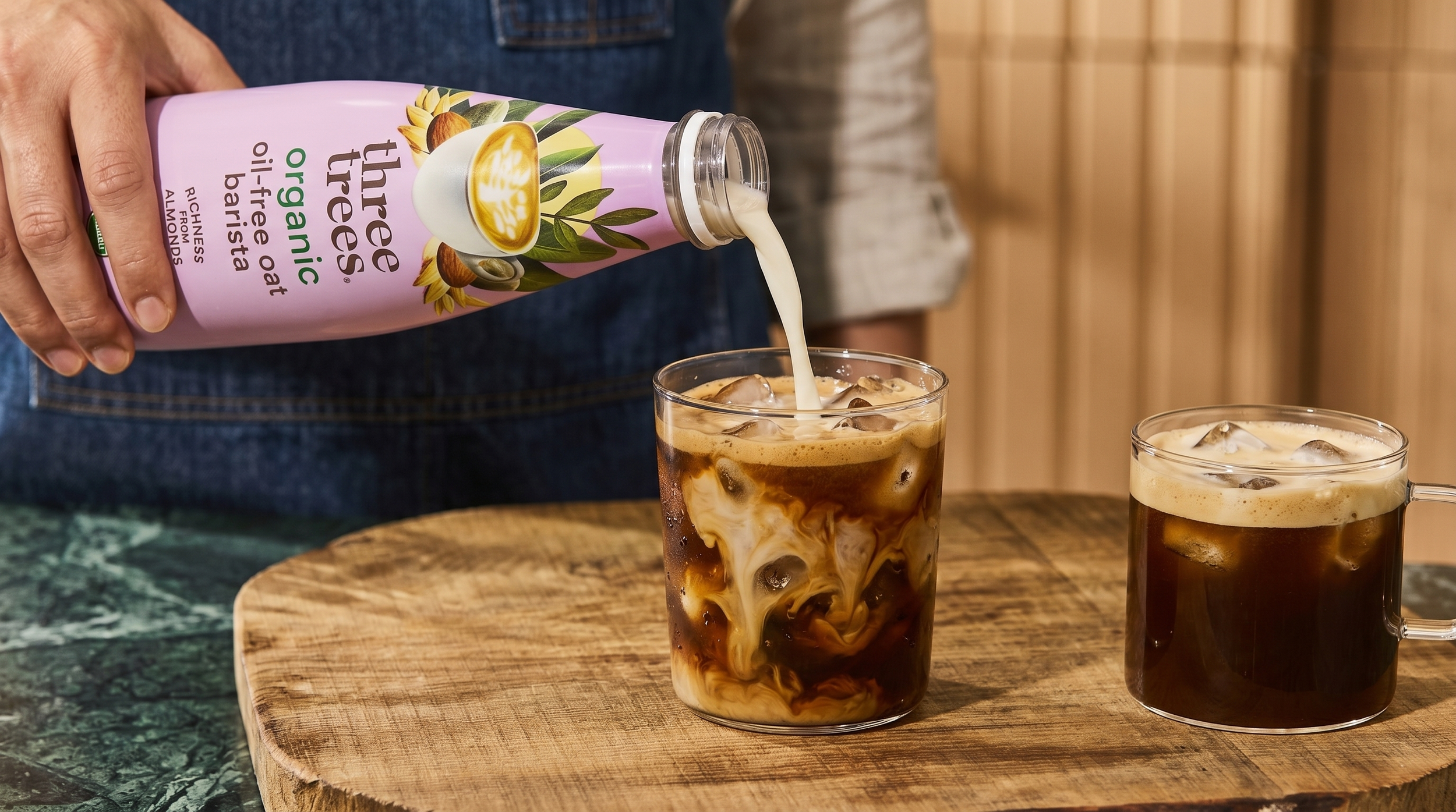
This is why Three Trees milks foam beautifully with nothing added — no gums, no sunflower lecithin, no acidity regulators. The nuts are doing exactly what they're designed to do. The foam isn't a formulation trick. It's just what happens when you put enough of the real thing in the carton.
It's a simple idea that's surprisingly rare in the category. And for anyone who's ever read a plant milk ingredient label and wondered why there are twelve items on it — this is the alternative.
